What do getting married, becoming a home owner and having a baby all have in common? For me, they've all taken place in the past 2 years and required David and I to be on the same page when it comes to finances. Here's what we've learned,
in no particular order:
1. Account for both yearly and monthly purchases. Part of the reason I found sites like mint.com hard to use is anytime we had a bulk payment (like homeowners insurance) it made our budget look really off kilter. There was no way (I could find anyway) to "pay yourself" each month to save up for these big payments.
A large chunk of David's paycheck each month goes towards paying ourselves for future expenses. We itemize them in a separate tab. This past year we were blessed that all the money we set aside for traveling to family for the holidays was unnecessary because of our surprise move. We ended up using that set-aside money to pay our hospital bills from Caleb's birth, which we had seriously underestimated (oops!). Each year of life experience gives us a better idea of what to budget in these areas. Other yearly expenses include: dentist, gifts, auto, medical, etc. These are things that can be sky high one month and nothing the next.
2. Budgeting can be emotional, especially if you have to come to consensus with your spouse. When David and I set up our budget, it was the first time we'd ever had to consult another person about how each dollar would be spent. In fact, with both of us being pretty frugal by nature, it was the first time we'd set up a budget beyond "spend as little as possible."
At first, I felt very constrained by having an actual dollar limit. Sometimes I had to get very creative to live with in it and many times in those early months, I blew it completely. As time went on though, I learned many strategies that helped, rarely went over in any category and often had money left over which we were then able to save or give.
Because we set up our budget early in our marriage, I can honestly say David and I have never had a fight over how much someone spent. We've had a few looong discussions over how we wanted to spend money in the future, but because we are both living under the same "rule" of the budget, we've never had a "you spent WHAT?!?" moment. That's one of the best things about the budget to me!
3. It takes time realistic numbers for each category. It took several months of tracking our purchases, explaining our goals to one another and re-evaluating the budget to find the right balance. For instance, one of my priorities is eating organic milk, meat and eggs. David supports this and gives me a grocery budget that allows for it. My challenge? To be smart enough with what's left over to also afford organic produce when I can. Your goals may be different, but find a way to both allow money for things that are dear to your heart while still challenging yourself.
3. Plug in your numbers frequently. As those who read my blog often already know, I got caught by not doing this in January. A budget is no good if you don't know where you stand in it. Even better? Put the cash you have to use for things like grocery's and eating out (easy places to go over) in an envelope.
4. Dream Big. A budget seems constraining if it's not helping you achieve some dream. We have 2 big goals that make the budget worthwhile to me. One is to pay our home off in less than 10 years. This seemed like a huge, unachievable goal when we set it, but we have seem amazing progress and are currently on track to meet this goal. Each time I deny myself something small now, it's so much easier when later that month I get to make an extra payment on our principle.
The second goal that keeps us going is giving. It can be tempting to say, "I'll wait to give until I don't have a mortgage, then I can really give". However, we believe that he who is faithful with little will be faithful with much too, so we are trying to be faithful with our little. Plus, I don't want those who are going without something today to wait until I have achieved my dreams before they receive what they need spiritually and physically.
Finding a balance between a personal dream and giving is tough. For us, we commit to give and those commitments are honored first, then our monthly bills, then extra goes toward the house.
5. When life changes, the budget will probably need to change too. Part of the reason we are so passionate about paying the house down now is we know as we add kiddos, there will be less "extra" at the end of each month. Don't try to make the same budget work for 10 years. At the very least, re-evaluate every new year. When we first started budgeting we re-evaluated every month!
6. Be creative. It's amazing the areas of our budget we've been able to cut. We still enjoy life, we just find less expensive ways to do it. We don't watch much TV so instead of cable we do netflix, we take advantage of any discounts for paying "up front" instead of month by month (we save on our garbage service, homeowners insurance and car insurance by doing it this way) and we think outside the box when it comes to entertainment. It never ceases to amaze me where we've been able to find savings now that we watch where our money goes.
7. See how simply you can live. This is a new one for me. I started realizing how much stuff was cluttering up our home simply because I got a coupon or "good deal" on it. Sometimes, that's a good thing, I love having a freezer full of meat I got a good deal on, but getting a good deal on unnecessary items is not a good deal. I didn't think I was buying unnecessary things until I started looking for ways to re-purpose what we already had around the house before buying something I though we "needed".
I've realized keeping a lot of extra "things" in the home wastes not only money, but the time it takes to organize and clean those things.
8. When it's time to buy- used items are my friend. From cars to clothes, this has been a huge savings for our family. Craigslist, consignment shops and even yard sales can be great sources of gently used items.
9. Things you only need to use once can be borrowed. This is especially true of tools. Recently, David borrowed a wood plane to help the doors in our house fit correctly. Since we'll probably never use something like that again, being able to borrow instead of buy was definitely a blessing. If you're worried about asking for too many favors, consider offering a trade. David often offers to be tech support to the lender should they ever need it.
Wednesday, June 15, 2011

Monday, June 6, 2011
Is It Worth It?
One of my favorite bloggers, Kara, over at Simple Kids likes to say, "My family's simple may be your family's complicated." Can I just say this is so true?
When I meet new people I often get questions about why I do one thing or another, which I have no problem sharing about. In fact, part of why I write about the things I'm leaning on our blog is because someone told me about it, I tried it, loved it and figure someone else might too!
However at the end of the explanation, I'm often asked if I think ________(insert one of the following: cloth diapering, yogurt making, veggie growing, baby food making, etc.) is "worth it"?
There is no other question I find so difficult to answer! For our family some of the above have been worth it, others have not. I have no idea if any of them will be worth it for your family.
I can however, answer the question: How do you (Sarah) decide if something is "worth it"?
To be worth doing, a task has to meet several criteria for me, and I think the final one is the most important:
1. It benefits our family in some way
2. The time required does not exceed the value added
3. The type of challenges involved feed my soul, not drain it dry
For instance, cloth diapering is probably the thing I get asked about the most. To me, it benefits our family by saving us money, only adds two loads of laundry to my week and I love laundry. It's out there. I said it. Doing laundry, hanging clothes out to dry all bring peace to my heart. Not having to worry about running out of diapers simplifies my life. It's worth it.
Making my own baby food however, turned out to be another story. I was hoping this would be another money saver, but it turned out that a bag of organic frozen veggies combined with a handful of organic meat costs only pennies less than the same amount of organic jarred baby food. And then I had to wash the food processor. I hate dishes. It's out there. I said it. Seeing dishes piled up on my counter top, cluttering my food preparation area drains me. It wasn't worth it.
I think however, that all the things we learn and try, whether we stick with them or not, benefit us. I still make homemade baby food in a pinch (aka: Caleb ate faster than my subscribe and save shipment from Amazon could travel).
There are lots of wonderful things other families do that make me wonder "would that be worth it for our family?" Sometimes the answer is yes, sometimes it's no. Either way, I love looking at parenting as something I can learn from others about and be encouraged in, not as something that's a competition. That can be hard when you really admire something someone else has said "Yes" to.
There are several things I've seen friends try that have made me feel this way. Should I be doing that too? It seems to save them so much money. But for each money saver, there is usually a small time investment. And there are only so many chunks of time in our day to give away. And that's why I only choose money savers that also give me joy.
Friday, June 3, 2011
Friday Favorites: Broth from Bones
I've had a couple people ask me recently exactly what I do when I make chicken broth. I've mentioned my love of home made broth several times on here, but never really done a "step-by-step". So for those who are interested, here's what I do:
First, cook up a whole chicken (or bone-in chicken pieces) any way you please.
Eat up, then pick off any excess meat from the bones (great for soups!)
Once your bones are semi clean (there's still plenty of skin and fat left on mine usually) place them in a large pot.
Wash and chop up carrots, celery and onions into ~1 inch chunks. For my taste preferences I usually do 2 carrot sticks, 3-4 celery sticks and 1 large onion. Feel free to skip peeling the carrots and taking the leaves off the celery, both of these add flavor when left on. I've heard the onions don't need to be peeled either, but I haven't been that brave.

Toss the veggies into the pot with the bones and cover with water until bones are fully or almost fully submersed.
I also like to add several grinds of pepper, a pinch of sea salt and a bay leaf, but those are all optional.

Bring water to a boil, then turn down heat to low-medium and simmer for 1 hour.
Let cool, strain and freeze or refrigerate as desired.

Straining is the only tricky part in this whole process. I never realized this because I typically make my stock in one of the beautiful pots loving friends and family purchased from my bridal registry. The stock pours out of these perfectly, never spilling a drop.
During our stay in Florida, however, I made stock in the cheap cookware provided by the rental company and pouring was disastrous. The stock ran down the side of the pot and got everywhere. The moral of the story: pour your stock into a container safely located in the sink until your sure which type of cookware you own.
Also, I find it much easier to have one person stabilizing/holding the strainer while the other one pours the liquid through.
I was really intimidated the first time I tried this, but now I never throw chicken bones away before they've made some of this yummy broth.
First, cook up a whole chicken (or bone-in chicken pieces) any way you please.
Eat up, then pick off any excess meat from the bones (great for soups!)
Once your bones are semi clean (there's still plenty of skin and fat left on mine usually) place them in a large pot.
Wash and chop up carrots, celery and onions into ~1 inch chunks. For my taste preferences I usually do 2 carrot sticks, 3-4 celery sticks and 1 large onion. Feel free to skip peeling the carrots and taking the leaves off the celery, both of these add flavor when left on. I've heard the onions don't need to be peeled either, but I haven't been that brave.

Toss the veggies into the pot with the bones and cover with water until bones are fully or almost fully submersed.
I also like to add several grinds of pepper, a pinch of sea salt and a bay leaf, but those are all optional.

Bring water to a boil, then turn down heat to low-medium and simmer for 1 hour.
Let cool, strain and freeze or refrigerate as desired.
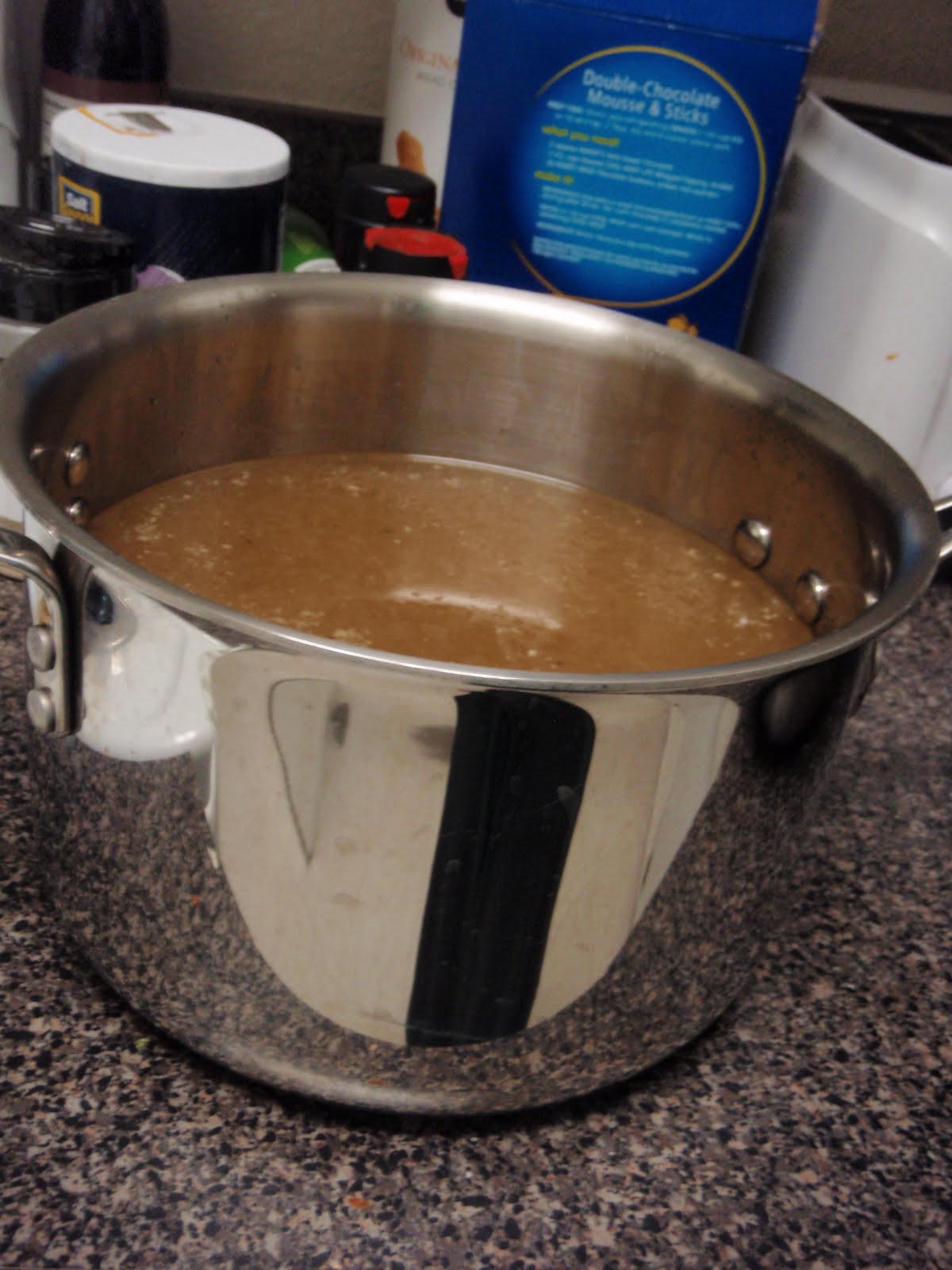
Straining is the only tricky part in this whole process. I never realized this because I typically make my stock in one of the beautiful pots loving friends and family purchased from my bridal registry. The stock pours out of these perfectly, never spilling a drop.
During our stay in Florida, however, I made stock in the cheap cookware provided by the rental company and pouring was disastrous. The stock ran down the side of the pot and got everywhere. The moral of the story: pour your stock into a container safely located in the sink until your sure which type of cookware you own.
Also, I find it much easier to have one person stabilizing/holding the strainer while the other one pours the liquid through.
I was really intimidated the first time I tried this, but now I never throw chicken bones away before they've made some of this yummy broth.
Subscribe to:
Posts (Atom)